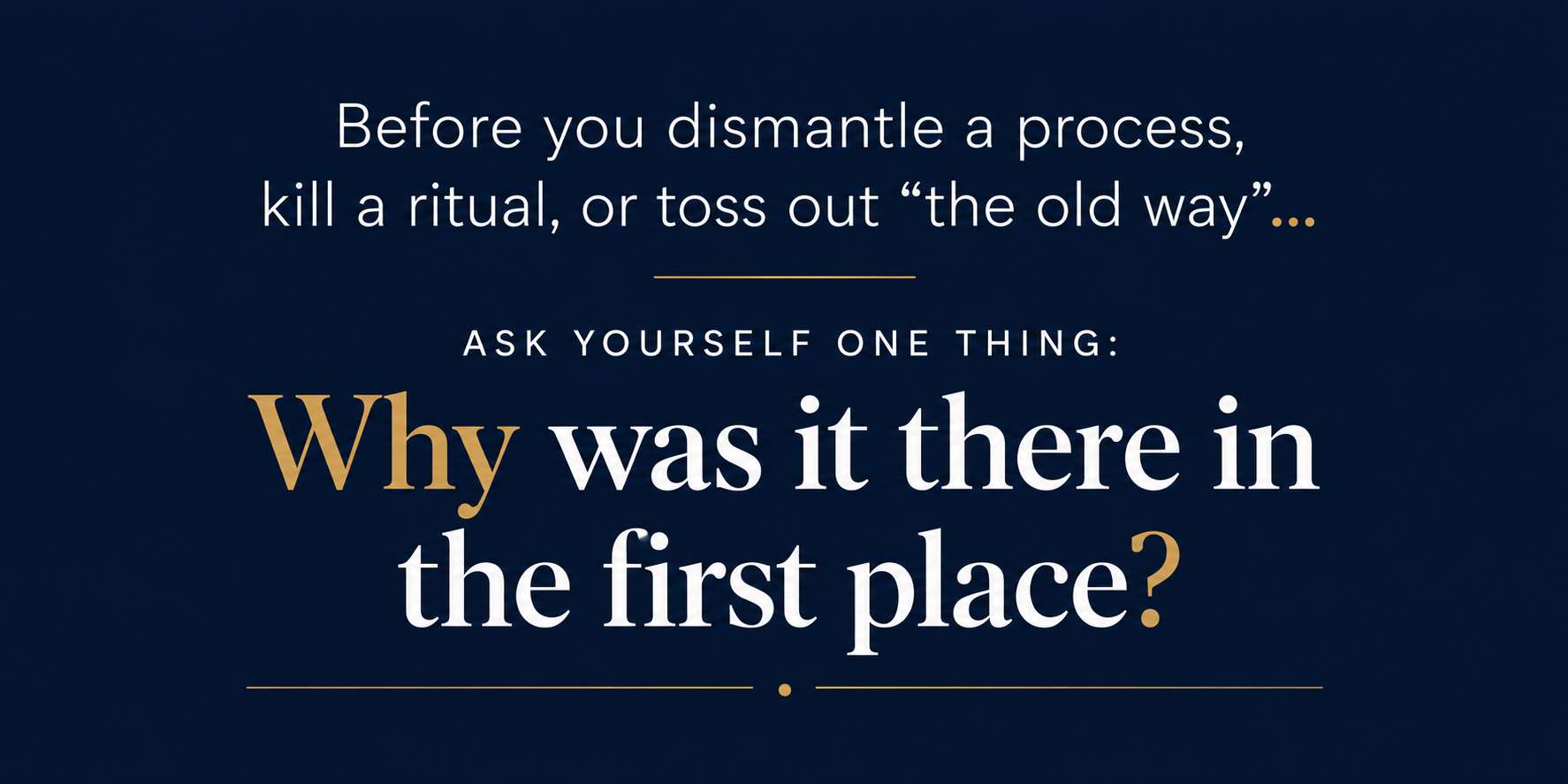
It’s called Chesterton’s Fence, a principle coined by English writer and philosopher G.K. Chesterton, and it offers a deceptively simple but incredibly important piece of wisdom:
“Never take down a fence until you understand why it was put up in the first place.”
The story goes: a reformer sees a fence in an open field and says, “This is useless. Let’s remove it.” But Chesterton urges caution. If you don’t understand why it was built, you’re not yet qualified to remove it.
In organisations undergoing transformation, this message is especially relevant. In our drive to improve, streamline, and modernize, it’s easy to fall into “shiny penny syndrome”, the pull toward change for change’s sake without full clarity on what’s already working or quietly holding things together.
Consider a simple example.
A team once held a regular 30-minute huddle. Over time, it came to be seen as inefficient and repetitive, and so it was removed. But its original purpose had been critical. It helped maintain rhythm during a period of instability, fostered informal recognition, and created space for connection between senior leaders and junior team members.
When the huddle disappeared, so too did many of those invisible benefits. What had been dismissed as outdated was, in fact, a quiet carrier of culture, a touchpoint for engagement, and a conduit for building trust.
Through the lens of Chesterton’s Fence, the outcome might have been different. Perhaps a reimagined 15-minute huddle, refined in structure but preserved in purpose, would have kept its value intact while responding to new realities.
As we drive forward in times of accelerated change, the questions we ask matter:
- What was the original problem this process or tradition was solving?
- Who benefits from it, even quietly?
- What unintended impact might arise from removing it?
- And is there a way to modernize it without losing its soul?
This is not a resistance to change. This is a call to lead it more wisely. Because sometimes the fence isn’t the problem. Sometimes it’s the foundation for something still needed, just not yet reimagined.